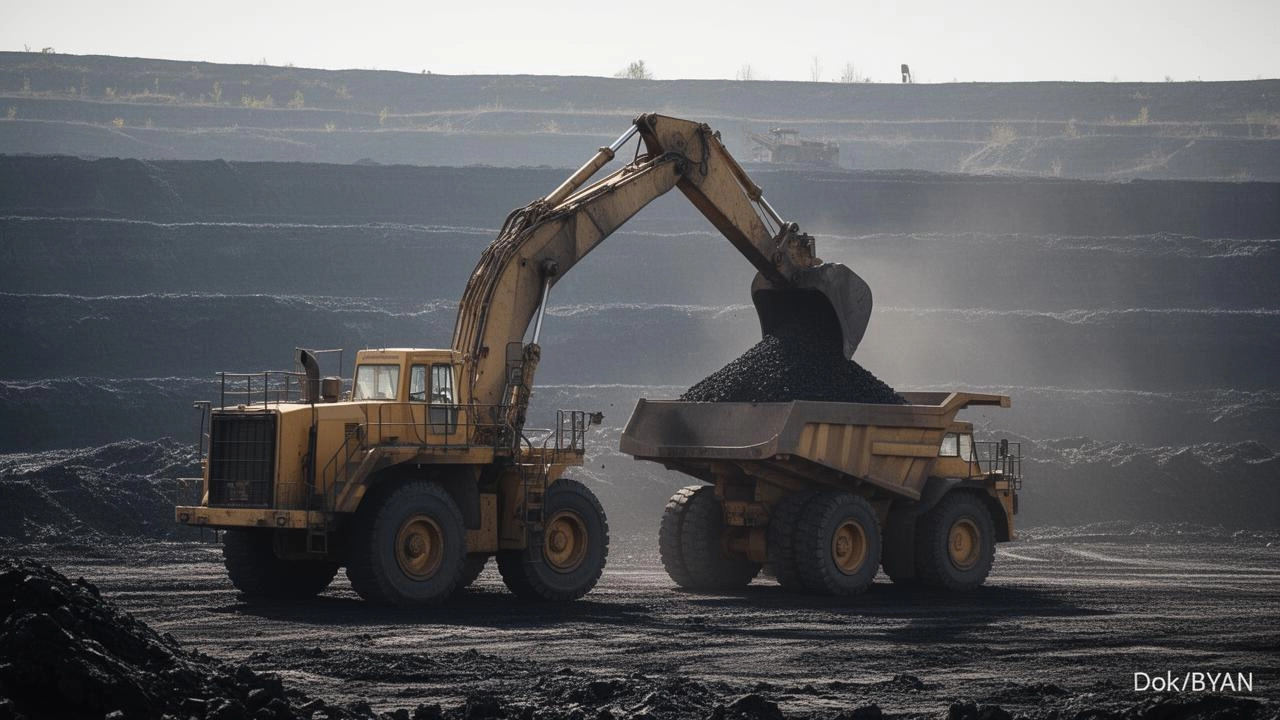
Finance Biggo - Indonesian billionaire Andi Syamsuddin Arsyad, widely known as Haji Isam, has signed a conditional agreement to acquire a 30 percent stake in coal miner Bayan Resources, a move that positions the 49-year-old from Kalimantan to become one of the dominant players in the global thermal coal trade.
The deal, disclosed in a stock exchange filing late Thursday, will see 10,000,000,500 shares transferred to Jhonlin Baratama, a company controlled by Haji Isam, from Bayan's two largest shareholders: founder Low Tuck Kwong and his daughter Elaine Low. The filing did not specify the transaction price or the conditions attached to the share transfer.
Haji Isam had earlier in September made a US$3 billion cash offer for a 62 percent stake in Bayan, according to people familiar with the matter. That bid valued the company at roughly US$4.8 billion. Whether the 30 percent stake agreement represents a first tranche of that broader ambition or a scaled-back transaction remains unclear, and neither Jhonlin nor Bayan responded to requests for comment.
The announcement sent Bayan shares surging as much as 20 percent in Jakarta on Friday, the largest intraday jump in a month, putting the stock on track for a weekly gain of about 12 percent. Market participants are now awaiting further details on pricing and conditions to assess the longer-term implications for the share price, said Andreas Yordan Tarigan, an equity analyst at Sucor Sekuritas.
"But the market has been waiting excitedly for this to happen. It's always exciting when there's a jumbo transaction happening," he said.
Building a coal empire
Haji Isam's Jhonlin Group is already a significant thermal coal producer, having requested a mining quota of 60 million tonnes for 2026, according to a Bloomberg report in July. Bayan, meanwhile, produced approximately 68 million tonnes in 2025. A combined operation would push Haji Isam's output beyond industry majors like Glencore, trailing only Indian and Chinese miners that primarily sell into their domestic markets.
| Producer | Output | Basis |
|---|---|---|
| Bayan Resources | 68 Mt | Actual output, 2025 |
| Jhonlin Group | 60 Mt | Mining quota requested for 2026 |
| Combined | 128 Mt | Illustrative sum of the two |
| Glencore | 98 Mt | Energy coal output, 2025 |
Note: Jhonlin's figure is a quota it has requested for 2026, not confirmed production, so the combined total is illustrative rather than a like-for-like comparison.
If he ultimately secures a controlling stake, the entrepreneur would oversee the largest coal operation in Indonesia, the world's biggest exporter of the fossil fuel. The scale of the consolidation underscores how individual tycoons are reshaping the country's commodity landscape amid shifting government policy on mining quotas.
The Indonesian government cut Bayan's production quota earlier in 2026, forcing the company to declare force majeure last week. Rivals such as Bumi Resources and Adaro Andalan were largely spared from the enforced output reductions, according to a Bloomberg report in February. That regulatory pressure may have created an opening for Haji Isam to negotiate from a position of relative strength.
The pressure runs deeper than a single quota cycle. Moody's Ratings cut its outlook on Bayan to negative from stable this week, keeping the company's corporate family rating at Ba1, and projected that output would fall to about 39 million tonnes in 2026 without additional quota approvals, down sharply from 68 million tonnes in 2025. The agency expects EBITDA to decline to US$700 million in 2026 from US$1.1 billion in 2025, well below its earlier expectation of roughly US$1 billion a year as production climbed toward a capacity of around 80 million tonnes.
Political connections and expanding influence
Haji Isam has rapidly emerged as one of President Prabowo Subianto's most favored business figures. He was among the largest financial backers of Prabowo's 2024 election campaign, and the president flew to the tycoon's coastal hometown of Batulicin the day after being sworn in to express his gratitude.
The businessman now oversees major government projects, including a one-million-hectare food estate in Papua, an initiative that has drawn scrutiny for its scale and environmental impact. His growing portfolio of state-linked ventures, combined with the Bayan acquisition, signals deepening ties between political power and extractive industries in Southeast Asia's largest economy.
Estimating Haji Isam's personal fortune is difficult because most of his businesses are unlisted. However, people who know him say his wealth easily exceeds US$1 billion.
Valuation questions remain
The Indonesian-language financial outlet Kontan reported that Bayan shares closed at Rp 11,525 on Thursday (Sep 17), valuing the 10 billion shares in the transaction at approximately Rp 115.25 trillion. Using the 90-day average price of Rp 12,486 per share, the stake would be worth around Rp 124.86 trillion.
If the US$3 billion figure from the earlier reported offer is applied to the 30 percent stake, the implied purchase price would be roughly Rp 5,250 per share at an exchange rate of Rp 17,500 per US dollar, a substantial discount to current market levels. That gap has fueled speculation about the nature of the conditions attached to the deal and whether additional considerations are involved.
| Shareholder | Stake Before Transaction | Shares Held |
|---|---|---|
| Low Tuck Kwong | 40.24% | 13.41 billion |
| Elaine Low | 22.00% | 7.33 billion |
Note: Ownership data based on publicly available records cited by Kontan.
Bayan was founded in 2004 by Singapore-born Low Tuck Kwong, who built the company into one of Indonesia's most profitable coal exporters. The potential transfer of a significant portion of his and his daughter's holdings to Haji Isam would mark a generational shift in control of one of the country's most valuable mining assets.
For investors, the transaction raises immediate questions about governance, pricing transparency, and the strategic direction of Bayan under a new controlling shareholder with close ties to the presidential palace. The company's recent force majeure declaration and quota cuts have already pressured operations, and the entry of a politically connected buyer could reshape how the miner navigates Jakarta's regulatory environment.
The deal also carries broader implications for the global thermal coal market. Indonesia accounts for roughly half of global seaborne thermal coal trade, and any consolidation at the top of its producer hierarchy could influence supply dynamics, pricing, and the pace at which the industry adapts to the energy transition. Haji Isam's expanded footprint would give him outsized influence over a commodity that remains central to power generation across Asia, even as long-term demand faces structural decline.
The concentration matters for buyers across Asia. Japan brought in 163 million tonnes of coal in 2025, of which 27 million tonnes, or 16.7 percent, came from Indonesia, second only to Australia, according to Japanese Ministry of Finance trade statistics. Output and pricing decisions by Indonesia's largest producers therefore feed directly into fuel procurement for Asian power generators.
As details of the transaction emerge in the coming weeks, attention will focus on the conditions attached to the share transfer, the final price, and whether Haji Isam moves to consolidate control beyond the initial 30 percent stake.
Check news here!