05 October 2026
Macro Risks & Selected Stock
Market Commentary
0 comments

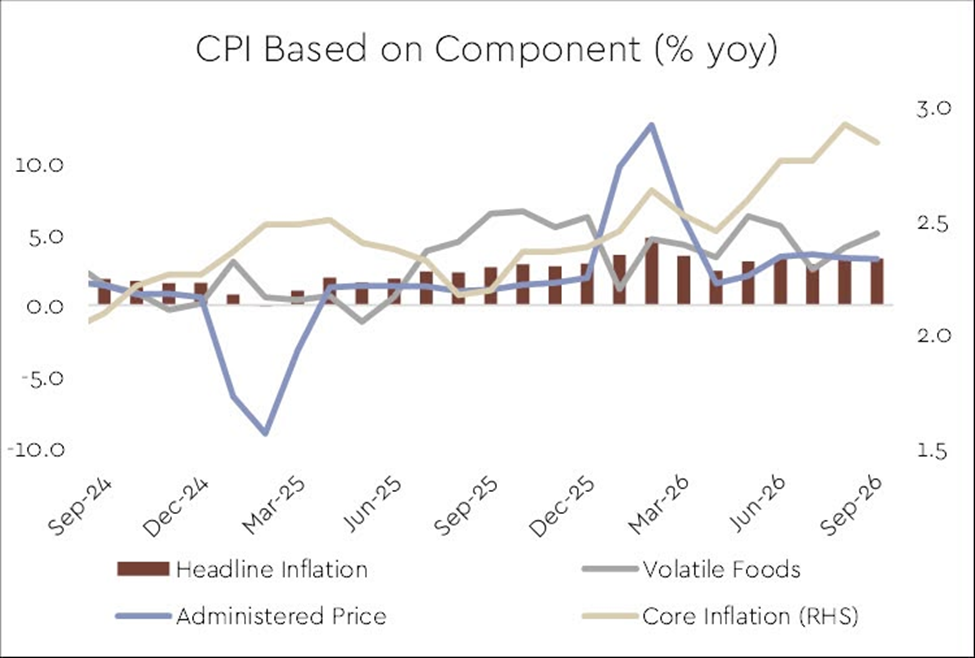
Indonesia’s September CPI came in at 3.28% yoy (vs. 3.19% in August), below consensus (3.30%) but above our forecast (3.08%), with MoM inflation also accelerating to 0.30% from 0.21%. Core CPI, however, eased to 2.84% yoy (from 2.96%), and excluding gold jewellery — which alone contributed 0.44ppt to headline inflation — we estimate core inflation at around ~2.2% yoy, suggesting that demand-side pressure remains relatively soft. The main pressure continues to come from the supply side, with food, beverages & tobacco (4.37% yoy) and transportation (4.84% yoy) as the key contributors. This points to imported inflation risks from rupiah depreciation and elevated oil prices amid ongoing geopolitical uncertainty. We still see room for BI to deliver another 25bps hike in 4Q26 to contain these risks, although the softer core inflation print provides some breathing room.
Beyond the inflation picture, attention is also turning to MSCI and its potential impact on foreign fund flows. The freeze on Indonesian equities looks unlikely to be lifted at the November 2026 review — our base case is an extension with neutral commentary, to be reassessed every three months, with low odds of a full unfreeze. At this stage, what matters is not only the freeze itself but also MSCI’s tone: a constructive signal could provide a positive catalyst, while tougher language around the potential Frontier Market downgrade could put further pressure on sentiment. The chances of a more constructive tone would improve if regulators announce additional reforms before late October. The impact is significant, with Indonesia’s weight in MSCI Asia Pacific ex Japan falling from 1.2% (December 2025) to just 0.5% (August 2026), while the number of constituents has declined from more than 20 stocks to 11. We estimate that around ~US$4.2bn (Rp75.3tn) of passive funds remain benchmarked to the index.
.png)
With macro risks and foreign flows still in focus, stock-specific catalysts become increasingly important. One example is AADI, which completed its divestment from Kestrel Coal Group on October 1st, selling its 38.4% effective interest to Yancoal for gross proceeds of approximately US$888mn. We view the transaction positively as it converts a non-core met coal stake into substantial liquidity and further strengthens AADI’s position as a pure-play Indonesian thermal coal company. It also opens the door to a potentially sizable special dividend as the clearest path to unlocking shareholder value. Assuming the full upfront proceeds are distributed (FX Rp17,800, 7.79bn shares), implied DPS would reach ~Rp2,029, equivalent to an 18.0% yield at Rp11,300, excluding contingent consideration and AADI’s regular operating dividend. Net debt adjustments and management’s capital allocation priorities remain the key factors to watch.
Written by Boris, the Broker
Comments