26 January 2026
Indonesia's Capital Flow
Market Commentary
0 comments

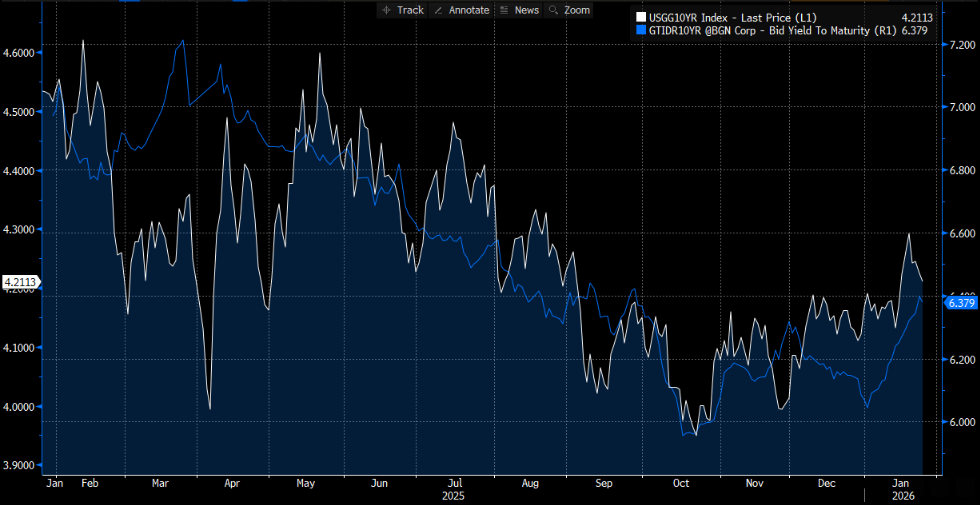
The US 10-year Treasury yields and Indonesia’s 10-year government bond yields are climbing simultaneously, but the key development for investors is the narrowing yield spread between the two. As the spread compresses, Indonesia’s relative carry advantage diminishes, reducing the incentive for global fixed-income investors to allocate aggressively to Indonesian government bonds. This can temper foreign bond inflows or even trigger selective outflows, especially from yield-sensitive investors who rotate back toward U.S. Treasuries as compensation for risk becomes more comparable.
For equity investors, this dynamic creates a nuanced asset-allocation shift. Rising bond yields raise the equity discount rate, which can pressure equity valuations, while narrowing spreads and potential bond outflows may weigh on the Rupiah—adding another layer of caution for foreign equity investors. As a result, foreign flows into Indonesian equities may become more selective, favoring defensives or domestic-demand names, while domestic investors rotate tactically between bonds and equities depending on yield attractiveness.
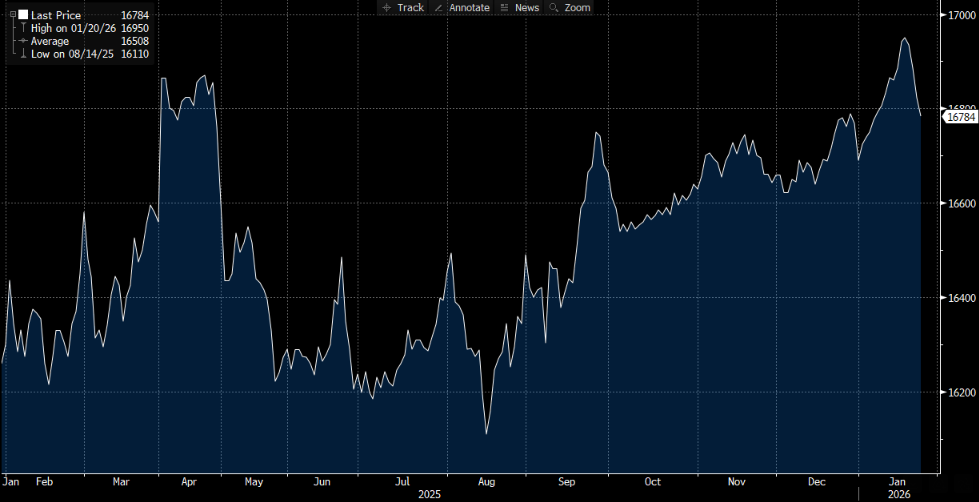
Having said that. the recent easing in Rupiah depreciation against the USD has helped stabilize investor sentiment by reducing fears that currency losses could erode equity returns. As FX volatility moderates, foreign investors gain clearer visibility on potential capital gains, making Indonesian equities more attractive on a risk-adjusted basis. This stabilization doesn’t necessarily imply a strong Rupiah trend, but it lowers the currency risk premium, allowing equity performance—rather than FX concerns—to regain prominence in investment decisions.
As external headwinds ease—helped by a Fed on hold and a more stable Rupiah—foreign investors’ concerns around FX-adjusted returns and bond-equity switching pressures begin to moderate. At the same time, narrowing yield spreads reduce the relative appeal of bonds at the margin which may encourage a gradual reallocation toward equities.
The banking sector stands out as a primary beneficiary of this shift. Accelerating credit growth and improving asset quality underpin a multi-year normalization in profitability, while current valuations remain below long-term averages, offering an attractive risk-reward profile. As capital inflows—both foreign and domestic—become more selective and fundamentally driven, banks provide a natural entry point due to their liquidity, earnings leverage to domestic growth, and reduced FX sensitivity. This supports a strategy of accumulating large-cap banks such as BBRI, BMRI, BRIS, BBCA, and BBNI, positioning portfolios ahead of a sustained recovery in credit growth and sector profitability.
For equity investors, this dynamic creates a nuanced asset-allocation shift. Rising bond yields raise the equity discount rate, which can pressure equity valuations, while narrowing spreads and potential bond outflows may weigh on the Rupiah—adding another layer of caution for foreign equity investors. As a result, foreign flows into Indonesian equities may become more selective, favoring defensives or domestic-demand names, while domestic investors rotate tactically between bonds and equities depending on yield attractiveness.
US 10 Year Treasury Yield (white) vs. Indonesia 10 Year Government Bond Yield
Having said that. the recent easing in Rupiah depreciation against the USD has helped stabilize investor sentiment by reducing fears that currency losses could erode equity returns. As FX volatility moderates, foreign investors gain clearer visibility on potential capital gains, making Indonesian equities more attractive on a risk-adjusted basis. This stabilization doesn’t necessarily imply a strong Rupiah trend, but it lowers the currency risk premium, allowing equity performance—rather than FX concerns—to regain prominence in investment decisions.
USDIDR Performance
As external headwinds ease—helped by a Fed on hold and a more stable Rupiah—foreign investors’ concerns around FX-adjusted returns and bond-equity switching pressures begin to moderate. At the same time, narrowing yield spreads reduce the relative appeal of bonds at the margin which may encourage a gradual reallocation toward equities.
The banking sector stands out as a primary beneficiary of this shift. Accelerating credit growth and improving asset quality underpin a multi-year normalization in profitability, while current valuations remain below long-term averages, offering an attractive risk-reward profile. As capital inflows—both foreign and domestic—become more selective and fundamentally driven, banks provide a natural entry point due to their liquidity, earnings leverage to domestic growth, and reduced FX sensitivity. This supports a strategy of accumulating large-cap banks such as BBRI, BMRI, BRIS, BBCA, and BBNI, positioning portfolios ahead of a sustained recovery in credit growth and sector profitability.
Written by Boris, the Broker
Comments