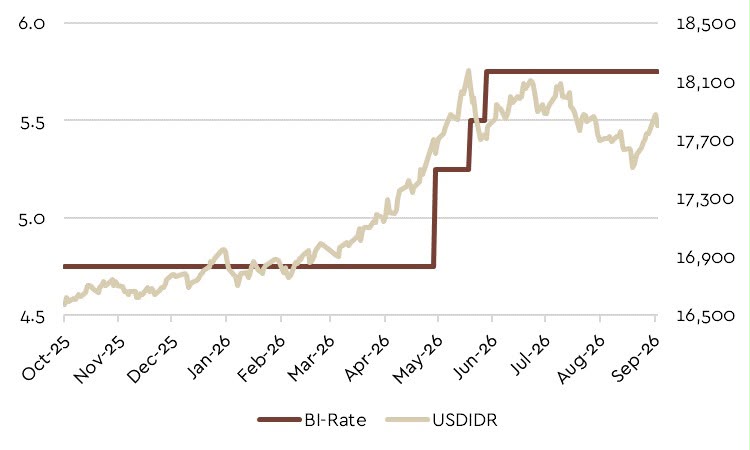
Bank Indonesia held the BI-Rate at 5.75% at its September meeting, in line with both our expectation and broader consensus. The Deposit Facility and Lending Facility were also maintained at 4.75% and 6.50%, respectively. The decision reflects BI’s continued focus on Rupiah stability while supporting growth through a broader policy mix, rather than further rate adjustments. On the credit side, loan disbursements grew 13.65% YoY in August, up from 13.58% in July, while BI maintained its 8–12% 2026 loan growth projection.
BI also confirmed that it will continue managing the money-market rate structure in line with the policy rate through pro-market operations. Despite a hawkish Fed, rising US Treasury yields, and generally weak global demand for emerging-market assets, Indonesia recorded US$0.4bn in net foreign portfolio inflows in 3Q26 through September 21, driven by government global bonds and local SBN inflows — a notable turnaround from the outflow pressure seen earlier this year.
On the incentive side, BI is increasing support for foreign funding costs across portfolio flows, bank loans, and FDI by expanding hedging incentives. Conventional swap discounts were widened from a flat 12.5% to 15–25% across 3–12M tenors, while DNDF discounts rose to 25% for 6M and 30% for 12M. The existing 10% LCT incentive was also maintained, with Singapore joining the LCT framework in August.
Overall, the latest move signals a greater reliance on market-based operations and hedging incentives to support liquidity and foreign inflows. BI appears set to make greater use of hedging incentives to facilitate foreign inflows, rather than relying solely on the policy rate. At the same time, the slimmer US–Indonesia rate differential could limit support for the Rupiah going forward. That said, BI reiterated its confidence in Rupiah stability, supported by strengthened pro-market operations, and expects USD/IDR to remain within Rp17,300–17,800 through year-end.