
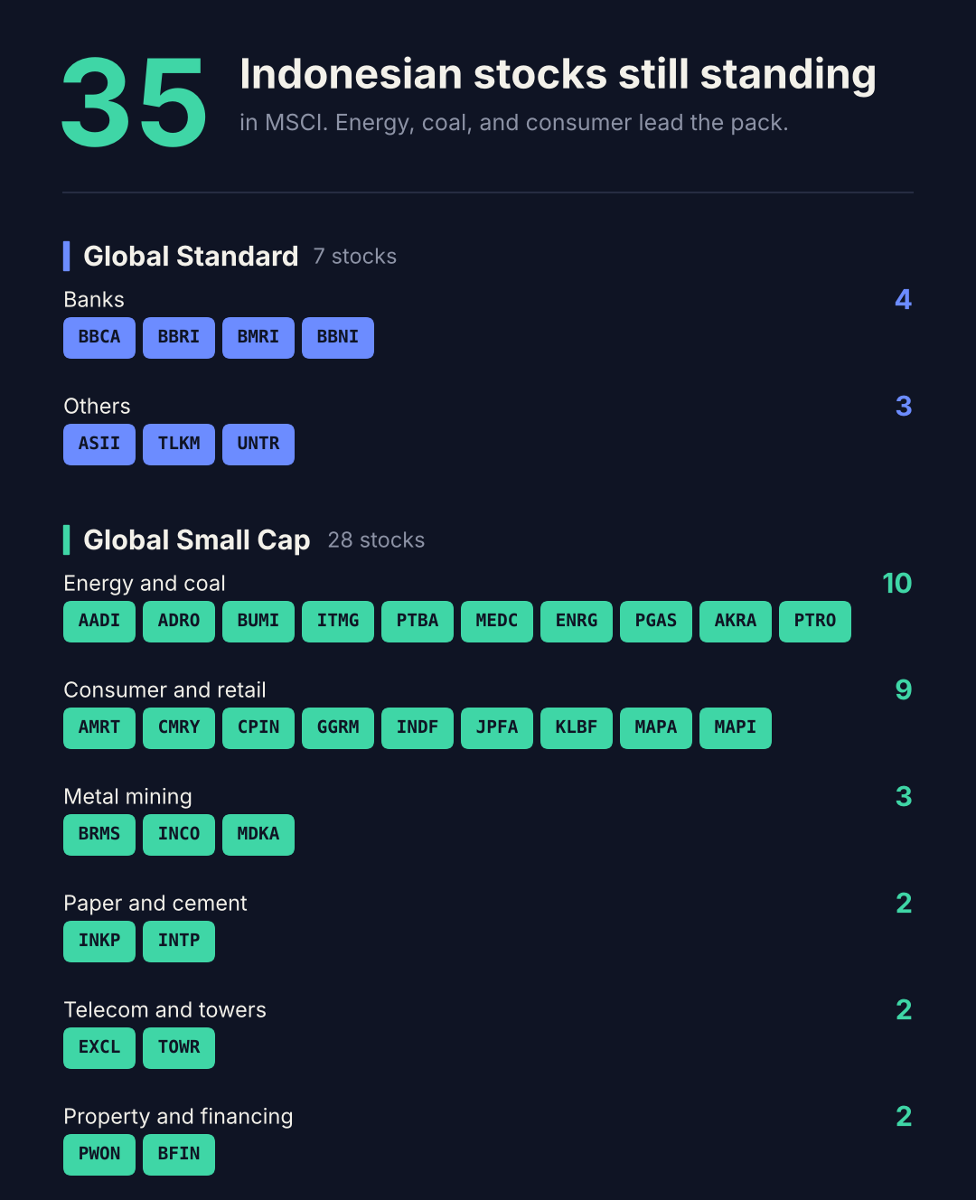
The IHSG ended its five-day winning streak, closing 0.21% lower at 5,115.04 on Wednesday, as investors turned cautious ahead of MSCI’s November review. Although the recent rebound offered some relief following the sharp correction earlier this month, market confidence remains fragile. MSCI’s latest announcement resulted in the deletion of BRPT and BRMS from the MSCI Indonesia Global Standard Index, with no additions announced. The changes will take effect after market close on 30 November 2026, potentially prompting portfolio adjustments among benchmark-tracking investors. However, the broader uncertainty surrounding Indonesia’s market classification remains unresolved, as MSCI’s consultation on a potential reclassification from Emerging Market to Standalone Market status is still ongoing, with a final decision expected by June 2027.
Adding to market uncertainty, the IDX has revised its High Shareholding Concentration (HSC) methodology, expanding the list of affected stocks from 83 to 383. Under the revised criteria, stocks are classified as HSC when 10 shareholders or fewer collectively own at least 92.5% of their shares, replacing the previous screening approach that included a Rp5tn market-cap threshold and Price Impact Ratio (PIR). The additional 300 stocks represent approximately 6.16% of IHSG market capitalization and are scheduled to be excluded from the index calculation starting 13 November. While the adjustment is intended to strengthen market transparency and investor protection, the broader coverage will also change the composition of the index, making its impact on market movements worth monitoring.
External pressures continue to weigh on domestic sentiment. US October inflation rose 0.4% MoM, above market expectations of 0.3%, reinforcing concerns that the Federal Reserve may maintain a more hawkish stance for longer. Meanwhile, the rupiah weakened to around Rp18,154/USD, adding to concerns over currency stability and potential pressure on foreign capital flows. These developments leave domestic equities exposed to shifts in global risk appetite, particularly as investors reassess their exposure to emerging markets.
In the near term, the IHSG is likely to remain volatile as investors assess the implications of MSCI’s latest review alongside the implementation of the revised HSC methodology. Potential portfolio adjustments following the deletion of BRPT and BRMS, combined with changes in the index calculation, may add to near-term market volatility. Meanwhile, rupiah stability and the broader uncertainty surrounding Indonesia’s market classification remain key factors to monitor. The sustainability of the recent rebound will depend on how the market absorbs these adjustments and whether investor confidence can gradually recover.