03 September 2026
Nickel Holds Gains as Indonesian Supply Risk Meets New AI-Driven Demand
Market Commentary
0 comments
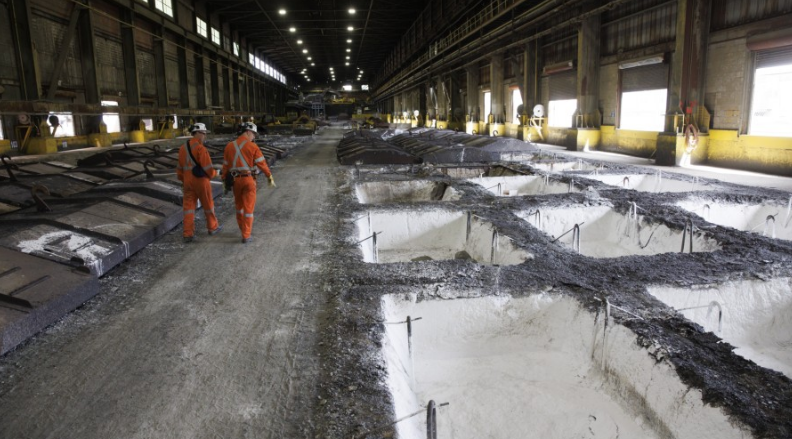
Nickel prices remained resilient, with only a mild pullback on 3 September after rebounding strongly the previous day, suggesting the market may be starting to respond to a new catalyst despite still-negative month-on-month momentum and ample LME inventories. The shift appears increasingly centered on Indonesian supply risk. The risk is tangible: Indonesia’s largest nickel complex could see water availability fall to just 40% of normal levels as an El Niño-driven drought constrains water supply for smelters. The potential impact is particularly relevant given the water-intensive nature of nickel processing, with HPAL requiring water across ore slurry preparation, acid-plant operations, washing, neutralization, and cooling, while RKEF relies on water for cooling, slag granulation, gas cleaning, and other utilities.
.png)
This adds to an already tighter 2026 ore quota of 260–270 million tonnes versus 379 million tonnes in in 2025. The combination of resilient price action and an as-yet-unconfirmed production cut suggests the market may be starting to price in potential supply disruption, rather than remaining anchored solely to the prevailing inventory-surplus narrative.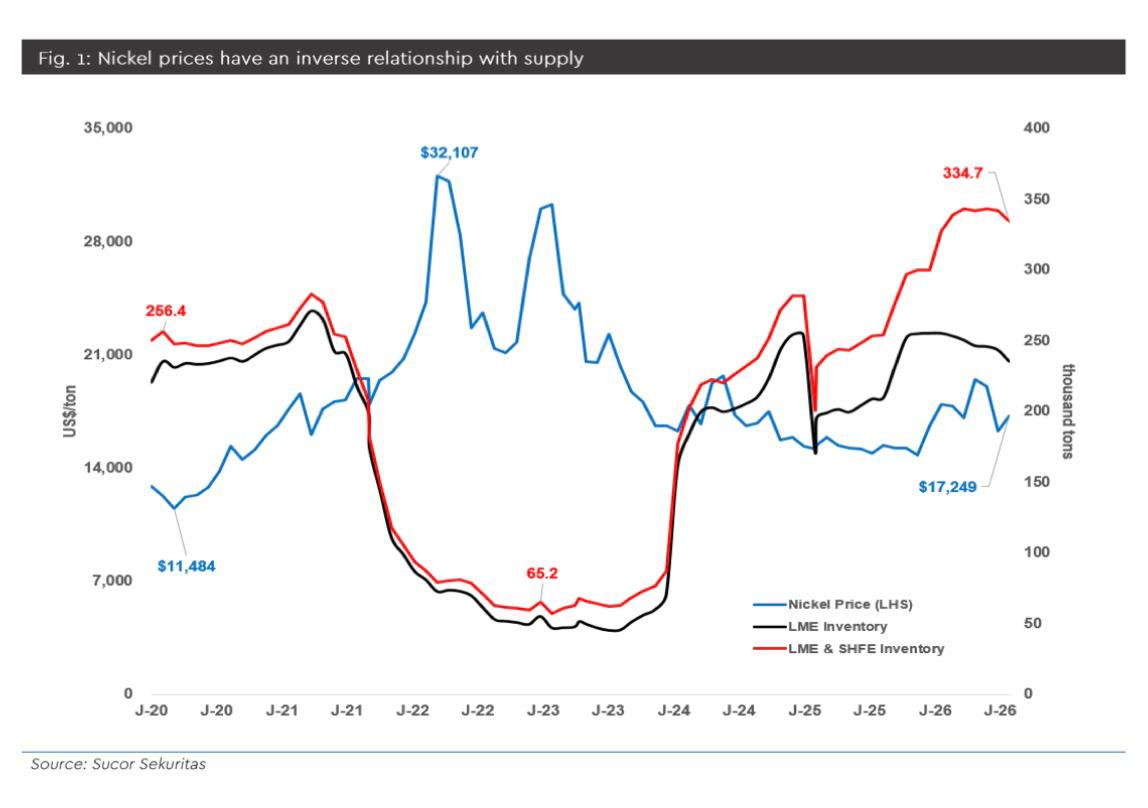
On the demand side, a clear divergence is emerging. China’s property sector remains a significant drag on stainless steel demand, with the prolonged construction slowdown weighing on nickel consumption. At the same time, AI data centers are emerging as a potential new structural demand driver. Hyperscaler backlogs have reached US$2.3 trillion, while the accelerating adoption of liquid cooling could create incremental demand for corrosion-resistant stainless steel used in piping, manifolds, valves, heat exchangers, and coolant distribution units. This could gradually broaden nickel’s demand base beyond its traditional exposure to stainless steel and EV batteries.This adds to an already tighter 2026 ore quota of 260–270 million tonnes versus 379 million tonnes in in 2025. The combination of resilient price action and an as-yet-unconfirmed production cut suggests the market may be starting to price in potential supply disruption, rather than remaining anchored solely to the prevailing inventory-surplus narrative.
The nickel price bounce could therefore be an early signal that the market narrative is beginning to rotate — from “oversupply and weak demand” toward “El Niño-driven supply risk + emerging AI infrastructure demand.” While it remains too early to call this a sustained trend, the shift is worth watching closely, particularly if nickel prices can maintain their recent rebound despite still-ample inventories and weak traditional demand.
We continue to favor MBMA for its fully integrated business model, spanning from ore mining to processing. The company is also steadily ramping up production toward full capacity, which should support stronger operational performance going forward.
Written by Boris, the Broker
Comments