
Ever since the Strait of Hormuz effectively closed in early March the global energy market dynamics have been completely shaken and will never be the same. The fallout from this escalation forced QatarEnergy to declare force majeure which instantly sent Asian spot liquefied natural gas prices soaring to around 25 US dollars per MMBtu.
.png)
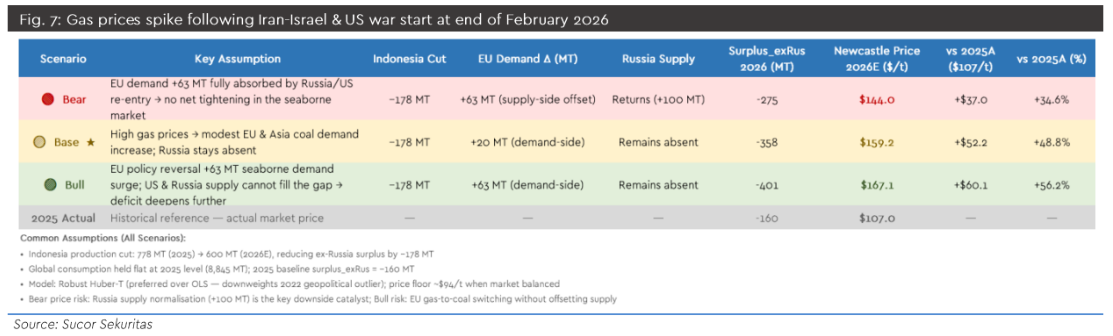
The disruption at the Ras Laffan facility wiping out roughly 20 percent of the global gas supply triggered real panic that is forcing industrial giants in China India Japan and South Korea to pivot back to thermal coal. This is exactly where Indonesia steps in as a crucial trump card. Our macro team projects that the combination of this massive demand shift with potential domestic production cuts could launch the Newcastle benchmark to 159 US dollars per ton or a sharp surge of nearly 49 percent from the previous year. This rare momentum clearly sets the main stage for our top energy names to reap an extraordinary windfall.
Every great story carries a plot twist however and this time it comes from our fiscal posture puzzle. Even though the coal price surge has the potential to massively boost state revenues by up to 28 point 8 trillion rupiah unfortunately this windfall is almost entirely wiped out by the swelling energy subsidy burden caused by the simultaneous spike in global crude oil prices which could drain an additional 309 trillion rupiah. Instead of narrowing our fiscal deficit is actually threatening to widen past 3 point 31 percent of GDP which risks breaching the legal statutory limit. To avoid the worst case scenario policymakers are projected to have to take decisive steps by cutting subsidies by around 100 trillion rupiah and raising subsidized fuel prices by 20 to 40 percent to keep the budget sane and disciplined.
Responding to this extreme tension on the global and fiscal fronts Bank Indonesia has certainly prepared its antidote so the capital market does not lose its direction. The central bank will most likely execute an operation twist strategy by keeping SRBI yields elevated to attract foreign capital while allowing short term interest rates to gradually rise. This elegant maneuver is designed to create a flatter yield curve with a target spread of around 80 basis points between the 2 year and 10 year government bonds keeping the 10 year yield stable around 6 point 85 percent by year end.
.png)
Ultimately this tectonic shift in the energy market is not a signal for investors to step aside but rather a golden momentum to recalibrate asset allocation tactics to maximize returns while the commodity cycle wave is fully in our favor.